

In my last post — The Rise of the Aspie — I told a story of how one technological paradigm — broadly, software and the internet — increased the returns to an Asperger-y cognitive profile. In this essay, I give one plausible candidate for the forward-looking version of the question: What will the age of language models reward and punish?
My hypothesis is that LLMs are a gift to those on the ADHD/executive dysfunction spectrum. The claim is that this cluster of traits, previously a clear impediment to being effective in the world, is becoming much less of one.
If the Aspie archetype is someone who has headphones on and sits at their desk obsessing over every fine detail, the ADHD archetype, or at least the version this essay is about, is a headless chicken with flashes of brilliance. It’s someone who is easily distracted, jumps from task to task and finds it hard to both finish projects and get started; someone who stares at a blank screen for 11 and a half minutes, visibly unable to coalesce the noise in their head into what could reasonably be called a thought.
For a person to function as a coherent agent across time, future consequences need to provoke action in the present, being salient enough to override more imminently gratifying and engrossing, or less aversive paths, and persisting until the next step in the desired direction is executed. So there are two jobs here: making the future felt now, and holding the thread until that’s done. Since we’re agents with a multiplicity of values and a hierarchical web of goals, this process has to be repeated at multiple levels: while figuring out what to do, planning how it will get done and actually getting it done.
Executive function regulates what we do when, much like a CPU scheduler, and executive dysfunction is a malfunctioning one. It can fail at either job. The first failure is one of salience, i.e., your higher-level thoughts are unable to produce emotional consequences salient enough to bring them to fruition. The functional emotional consequence that leads to the optimal action could be distress about the future, excitement about some versions of the future or just enough equanimity to make a more considered judgement.
The second failure is one of maintaining state, such that some task architectures impose significantly higher executive burden. A task with many steps, long-ish temporal gaps, need for context switches, etc. creates more moments where the chain can break.
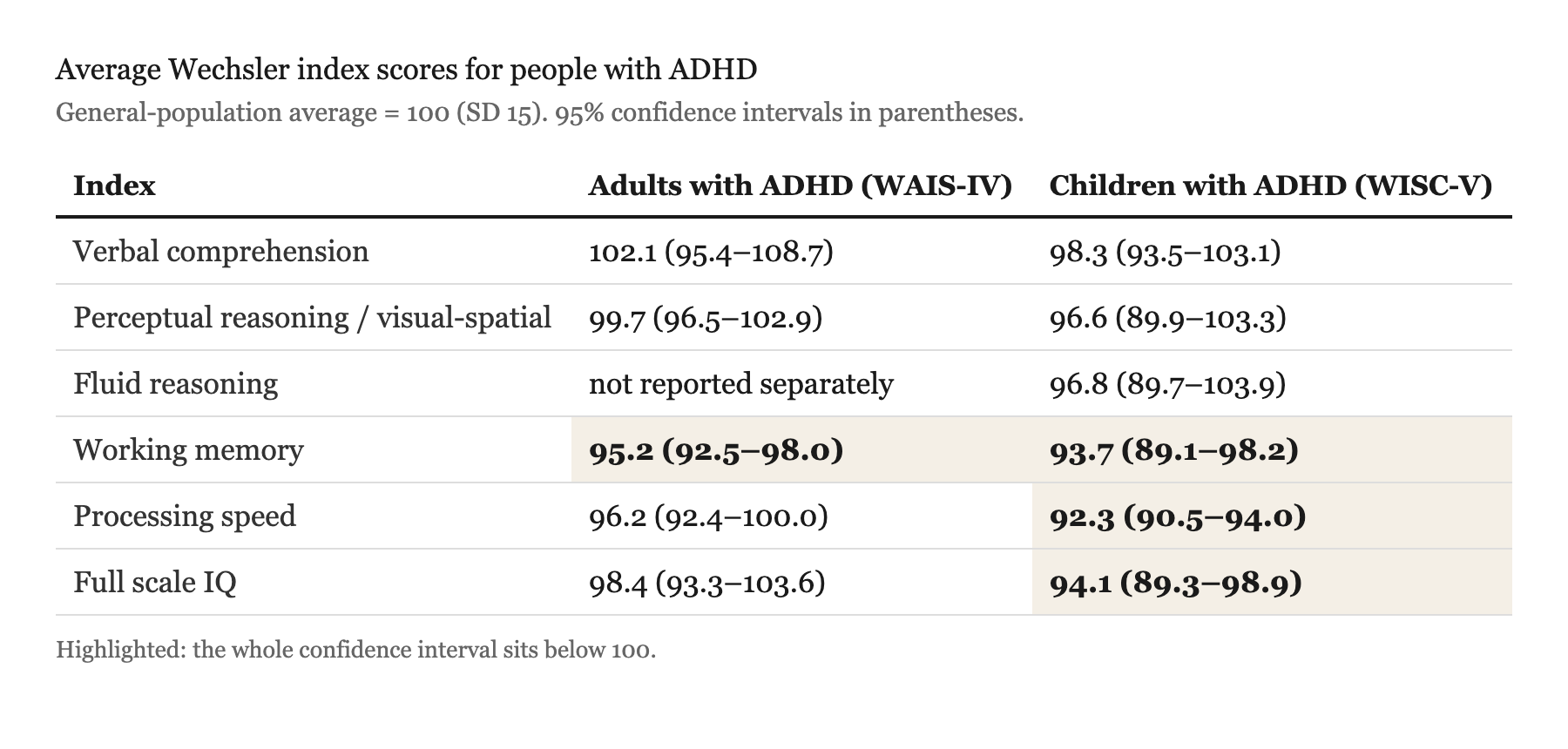
These failures seem to hit some parts of cognition much harder than others. On standard IQ tests, ADHD is associated with lower scores, by about 0.6 standard deviations.1 But when broken down into sub-facets, the effects are barely detectable on verbal and perceptual reasoning and clearly negative on working memory and, in children, processing speed. Another interesting result comes from simple reaction-time tasks: people with ADHD can respond about as fast as anyone, but do so much less consistently.2 In other words, the capacity to reason is much more intact than the ability to hold things in mind and stay engaged without lapses. LLMs turn out to be a great complement to this profile.
As an example, consider desktop research that features widely in knowledge work today, perhaps as part of a literature review or a market research project. Before LLMs, one could fail at this task in many more ways than simply making an analytic or conceptual mistake.
One had to persist through many low-reward steps (try different queries, find datasets, etc.) and resist attentional capture (following a trail of drifting hyperlinks). If you failed here, you basically failed. It didn’t matter how well you could interpret the data if you couldn’t find the data in time and/or keep yourself motivated to finish the project.
LLMs have changed the shape and feel of such projects. The extent to which the user understands their own goal and is able to analytically probe and steer towards it drives much of the variance in output quality. A lack of curiosity and adequate skepticism will still result in failure. But steps below a certain level of abstraction can just be delegated reliably.
LLMs help with both failures: they hold state for you (within a session and across days), and they lower activation energy for the next step. In practice this shows up as three different things:
1. They take over well-specified but tedious tasks.
2. They make it easier to start and keep going by giving you something to react to.
3. They lower barriers to creating systems that mitigate executive dysfunction.
#1 is clearest in the research example. Think of research as a hierarchy of tasks. As you go down the tree, the tasks become better specified, because they serve a goal that has already been set above them, but also longer, more sequential and duller. At the top, one reasons mostly with compressed concepts and models, which leans much less on working memory.
#2. This is the activation-energy half. Many people, across levels of executive function, feel like LLMs have somewhat solved the cold start problem. Each response is something concrete to react to, which provides some salience and stimulation. Still, this is a bigger gain for people who were more bottlenecked by this tendency.
#3 There is a certain interaction between people far out on this spectrum and other ‘normal’ people, about 95% of which happens on Reddit, but I’ve certainly experienced it in real life too:
ADHD guy: “How should I like get my shit together and get organized. I miss deadlines, meetings, forget to write down things.”
Normal guy: “Hmm, just find a to do list system that works for you and stick with it.”"
I’d bet that how reasonable this sounds to you is actually a pretty good indicator of where you are on this spectrum. Knowledge work necessitates externalizing one’s intention and creating execution infrastructure like to-do lists, reminders, reviews etc. This is even more the case for people with poor working memory. But creating and maintaining such infrastructure itself requires executive function.
A person can know the right move in some cognitive sense and still fail at the administrative handoffs that make it likely to get done, such as writing it down, doing so in a place where you’ll check later, actually remembering to check, etc. LLMs will clean up your half-baked thought or instruction, write relevant things into documents, file them in the right folder and retrieve them when asked, so long as you’re willing to make a decision once on how you want things handled in that type of situation. After that, organization becomes a byproduct of working. And when your particular weakness slips through anyway, it’s now trivial to build a tool around it. For example, I receive phone calls 5 minutes before a meeting starts and 5 minutes into a scheduled meeting, to make sure I’m actually in it.
Executive dysfunction is a failure to bridge the distance between intention and action. Some people have always delegated around their weaknesses, but that takes a baseline of success, and reaching that baseline often requires some modicum of executive function. LLMs are cheap, always on, and a way out of that cycle.
None of this makes ADHD a superpower, as people sometimes like to claim. The findings around ADHD being associated with higher divergent/creative thinking for example are quite weak. (We should note, though, that creativity is hard to measure experimentally, and that real-world creative output might be bottlenecked by the same factors.)
Executive dysfunction itself is a weakness, not a strength. But in the past, it was a weakness that could render other strengths functionally useless due to the multiplicative nature of the value creation process. LLMs may help change that.
---
[1]: Frazier, Demaree & Youngstrom, “Meta-Analysis of Intellectual and Neuropsychological Test Performance in Attention-Deficit/Hyperactivity Disorder,” Neuropsychology 18(3), 2004; “Cognitive Profile in Autism and ADHD: A Meta-Analysis of Performance on the WAIS-IV and WISC-V,” Archives of Clinical Neuropsychology 39(4), 2024. The sub-facet pattern is clear in children and weaker in adults.
[2]: Kofler et al., “Reaction time variability in ADHD: A meta-analytic review of 319 studies,” Clinical Psychology Review 33(6), 2013.