

Alex Karp has been in the news since his interview with Andrew Ross Sorkin. Some professional commenters seemed confident that Karp’s mannerisms belied not his neurodivergence but his fondness for a drug that its users fondly call ‘cocaína’. I’m less sure, not least because cocaine is an incredibly inefficient stimulant, even for billionaires. But I digress..
Soon after Karp’s interview, Palantir announced its neurodivergence fellowship.
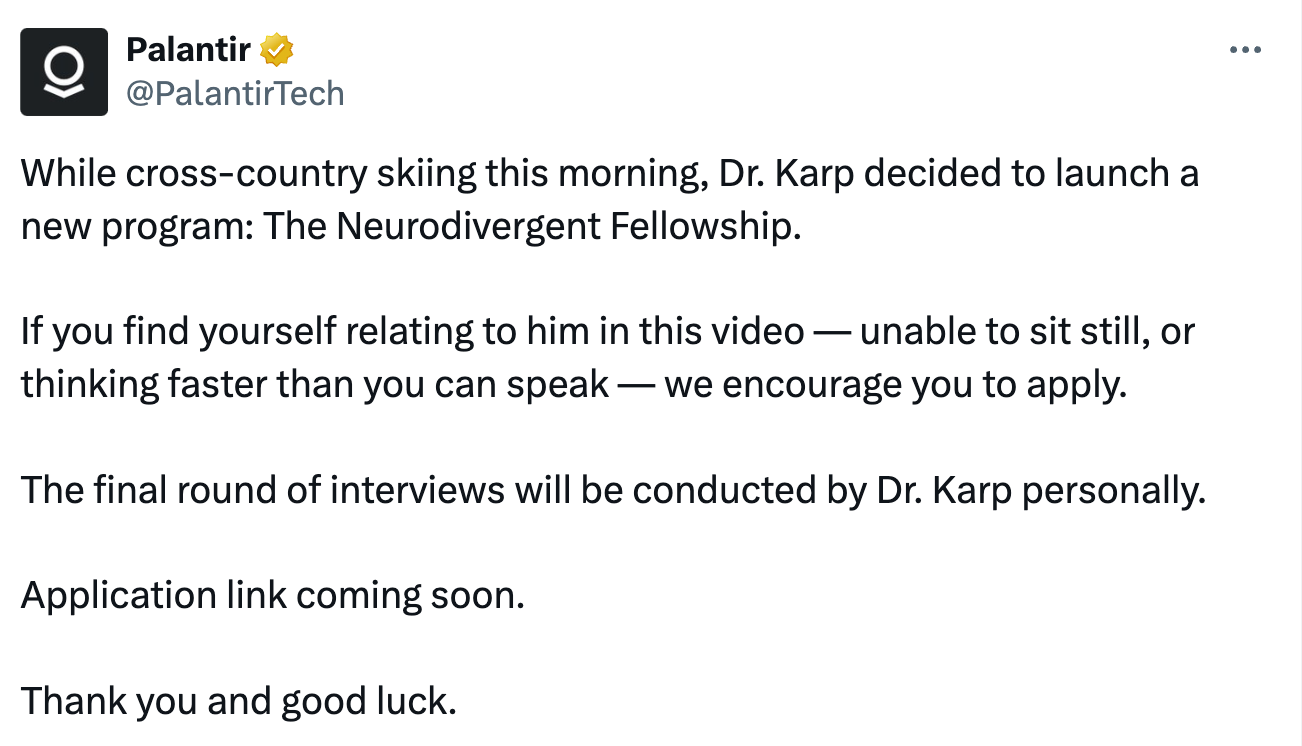
I fully expected the usual suspects to pile on, including from within the tech industry.
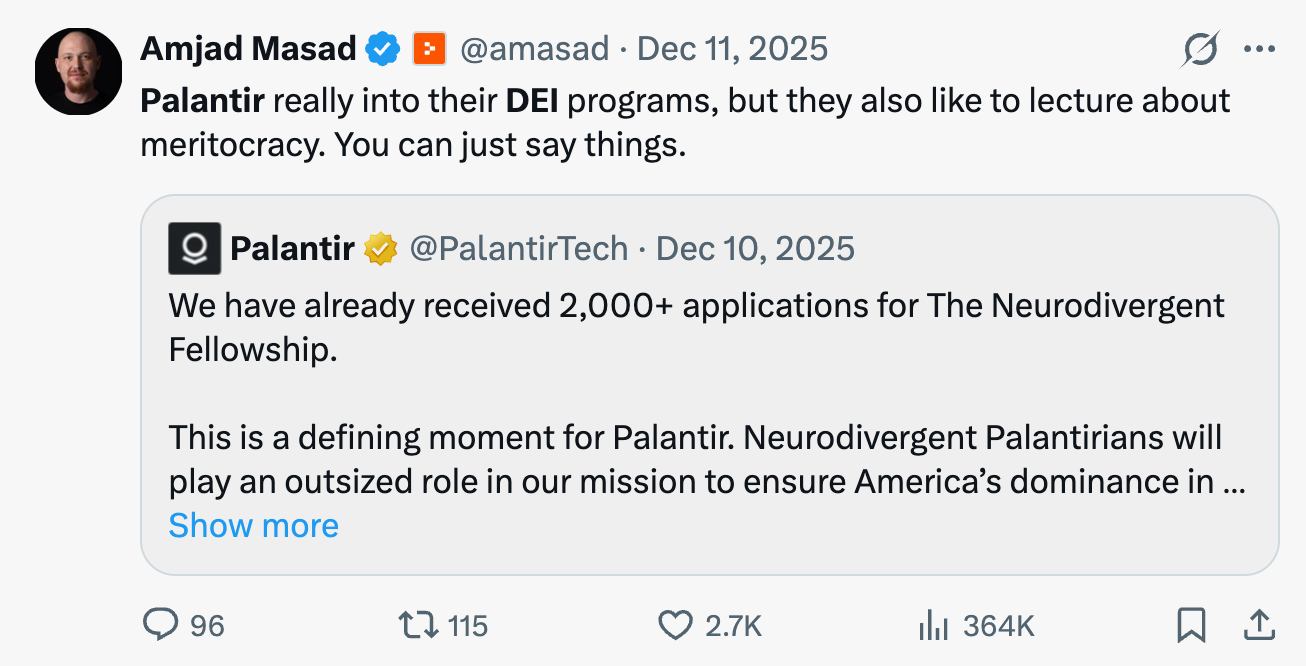
This is either intellectual laziness, or just plain bad faith, from the CEO of Replit. The reasoning seems to go something like this: “neurodivergence is vaguely about “inclusion” and “diversity”; who makes special accommodations for the “dysfunctional” except the woke; Palantir is anti-woke; therefore, hypocrisy. QED.”
I don’t think so. Whether the Replit guy agrees or not, Alex Karp believes he’s neurodivergent. The most straightforward, not even charitable, interpretation is that he wants more people like him: neurodivergent and productive.
Having said that, one could reasonably ask: if neurodivergent people are just as productive as neurotypicals (or more) — why do they need a dedicated fellowship at all?
As a group, neurodivergent people underperform neurotypicals on nearly every measurable skill. There’s nothing special about them in aggregate — they just look worse. But aggregate comparisons obscure the fact that some categories of neurodivergence show higher variance between their strongest and weakest abilities.
For example, individuals with ADHD and dyslexia show preserved reasoning abilities alongside impaired working memory and processing speed. This means that tests that involve time pressure and allow limited scope for externalizing working memory, will tend to underestimate their cognitive potential.
Now, if you’re an air traffic controller, time pressure and working memory aren’t arbitrary requirements. But in many knowledge work settings, the time pressure built into hiring filters is a result of the need to cheaply and accurately score candidates at scale. Timed tests are easy to administer and score; open-ended evaluations of reasoning ability are not. Add some path dependency, and you get a market that systematically underprices the skills of people who reason better than their performance in standard assessments would indicate.
The thornier problem is conscientiousness. Even among high-IQ neurodivergent people, conscientiousness tends to be lower. Meta-analyses find correlations of r = -0.40 to -0.50 between ADHD symptoms and conscientiousness — a large effect by personality psychology standards. Autism and conscientiousness are also negatively related. Conscientiousness, is by definition, a positive trait, all else equal. But I’d guess that large companies systematically overweight legible sub-facets (eg. orderliness) of conscientiousness to the exclusion of other traits that are harder to observe and measure.
Corporate environments tend to zoom in on legible inputs, since outputs can’t usually be measured and attributed correctly. People may not promote on the basis of punctuality and email hygiene, but they sure as hell will use the absence of these traits as reasons not to promote someone. Most high-functioning normies see these as table stakes since it comes easy to them. They go “if you can’t even do x, how will you do complicated thing y?”
This, I think, is at the core of what Palantir is getting at.
“If you can’t even do simple thing x, how will you do complicated thing y ?” is not a good heuristic if you care about value creation, and not simply minimizing downside variance.
Sometimes, the people who are bad at emails or exchanging pleasantries before meetings are capable of thinking deeply and thoroughly, and distilling complicated systems with clarity. It’s possible for someone who is less legibly “on top of it” to have much better conceptual intuition and produce quality that is significantly better, albeit harder to measure. (Ask my wife—I’m far better at helping her think through complex work issues by asking the right questions, than I am at folding laundry properly or remembering to add simple tasks to my to-do list.)
If my thesis is broadly correct, the specific mechanics of Palantir's fellowship matter less than what it signals: Palantir is an environment that welcomes spikes. They aren't interested in a holistic normative judgment of a candidate's "finesse" but whether this person is capable of producing outsized value when given autonomy and a team that complements them. Just as important is the implicit promise on workplace norms: we won't hire you and then slowly grind you down with expectations designed for someone else.
All sorts of people will apply to this program, including those whose resumes would have arguably passed the screen even without this dedicated fellowship- the right credentials, keywords that indicate relevant prior experience etc. These applicants may or may not be neurodivergent. (Neurodivergence is a spectrum anyway, and I don’t want to suggest that people to the left of me should automatically disqualify.)
If i were optimizing for the counterfactual impact of this program, I’d probably start by interviewing people I wouldn’t otherwise have, based on resume screening alone. Which is why “final interviews will be conducted by Dr Karp himself” sounds good, but doesn’t necessarily alleviate the failure mode I anticipate.
Assuming senior leaders at Palantir share Karp’s views, I wouldn’t worry too much that a talented neurodivergent person is rejected in the final round. It seems more likely that this person doesn’t get interviewed at all, since the initial screening is where scale and hard filters have the highest returns, and where it’s hardest to resist the appeal of standard tools.
You're being very generous with Palantir and super dismissive of Amjad. Amjad's point IS that companies like Palantir will work to diversify their hiring when its someone that's just like them (Karp) but will crap on DEI if it's people that are not like them. It's all the same shit. You want to beleive that Palantir is doing the ideologically consistent thing here because you beleive it includes you. It might not.
The rest of your musing is smart but people can make similarly smart arguments for DEI that have to do with culture, race, communication style, perception etc etc.
Don't be fooled because you want to beleive you're included.
Vaishnav,
You're describing variance optimization in high-dimensional skill space without realizing you've just argued for hyperbolic geometry.
"Spiky profiles" = high variance in individual dimensions. "Well-rounded" = low variance, clustered near the mean.
In Euclidean space, you'd minimize distance from center (standard hiring: "how close to average?"). In hyperbolic space, you maximize distance along specific dimensions (Palantir: "how far from average in the direction that matters?").
The "outlier advantage" you describe is literally the advantage of hyperbolic embeddings: rare, high-signal patterns are exponentially better separated in hyperbolic space than Euclidean.
Palantir isn't being "pragmatic about neurodivergence." They're doing what any organization optimizing for high-dimensional pattern recognition should do: hire for maximum variance along task-relevant axes.
You just accidentally explained why AI embedding spaces are hyperbolic. Congrats—you've been doing differential geometry this whole time without knowing it.